Basketball Battle
- 4.6
- Rating
- 50.00M
- Installs
- Free
- Price

 Analysis by App-foxy
I spent time with Basketball Battle as a quick, touch-focused sports game, and its main appeal became clear almost immediately: it turns a basketball matchup into a short contest of timing, positioning, and shot selection. It is not trying to replace a full basketball simulation. Instead, it gives me a compact way to play a few possessions when I have a spare moment, without asking me to learn a complicated control scheme first.
That focused approach explains why the game works for casual players. The presentation is easy to understand, the objective is familiar, and the free entry point makes it simple to try. At the same time, the game has enough room for mistakes and small improvements that I do not feel completely finished after one session. My honest view is that it is best understood as an arcade-style basketball game for quick competitive bursts, not as a detailed recreation of everything that happens on a real court.
Why the one-on-one basketball focus matters
The most important capability here is the way the game reduces basketball to a direct duel. Rather than surrounding the player with a large team-management layer, it puts attention on the immediate exchange between attack and defense. That changes the feeling of each turn. I am not watching a long play develop; I am deciding what to do with the small opportunity in front of me.
You May Also Like

 Google Keep - Notes and lists
Google Keep’s Quiet Growth Shows the Appeal of Simpler Notes
As mobile work gets busier, Google Keep keeps winning a simple contest: capture a thought quickly, find it later, and get on with the day.

 Blood Strike: 2.5 Anniversary
Blood Strike’s Loadouts Turn Every Drop Into a Tactical Gamble
A close look at Blood Strike’s custom loadouts: how fast access to signature weapons reshapes its battle royale rhythm, rewards preparation, and narrows the gap between fights.

 Pandora - Music & Podcasts
Pandora’s Music Is Easy to Start, but Harder to Recover
Pandora’s strength is its low-effort path from a seed to a station. Its weak spot is how much confidence it asks you to place in connection, setup, and quiet recovery.

 8 Ball Pool
 Is Built on Rivalries, Rematches, and Routine
A close look at the rivalries, rematches, shared routines, and unanswered safety questions that turn a quick pool match into a persistent mobile community.

 Samsung Music
’s Quiet Strength Is Playing What You Already Own
Its reach comes less from spectacle than from dependable access to a personal library. That simplicity is both the app’s strongest retention engine and its ceiling.

 AccuWeather: Weather Radar
AccuWeather Review: A Quick, Clear Forecast for Everyday Decisions
For everyday plans, the best forecast is the one you can understand quickly. AccuWeather makes rain timing, radar, and local conditions easy to act on, with a few trade-offs.
More From Our News Desk



In practice, this makes the game approachable on a phone. A full sports simulation can be impressive, but it can also demand more time, more controls, and more patience than I have during a short break. Basketball Battle is easier to pick up because the action is centered on a simple question: can I create a good chance and stop the opponent from doing the same?
The benefit of that design is concentration. A short match still feels like a contest because every possession has a clear purpose. A poor decision is noticeable, and a well-timed attempt feels satisfying without requiring a long tutorial. I found that especially useful when I wanted something more interactive than a passive sports app but less demanding than a large console-style game.
There is also a trade-off built into this capability. Players who enjoy realistic team tactics, detailed playbooks, and the full rhythm of five-on-five basketball may find the experience too narrow. The game’s strength is its directness, so anyone looking for a deep simulation should not mistake its accessible format for a complete basketball model.
What the controls ask from you
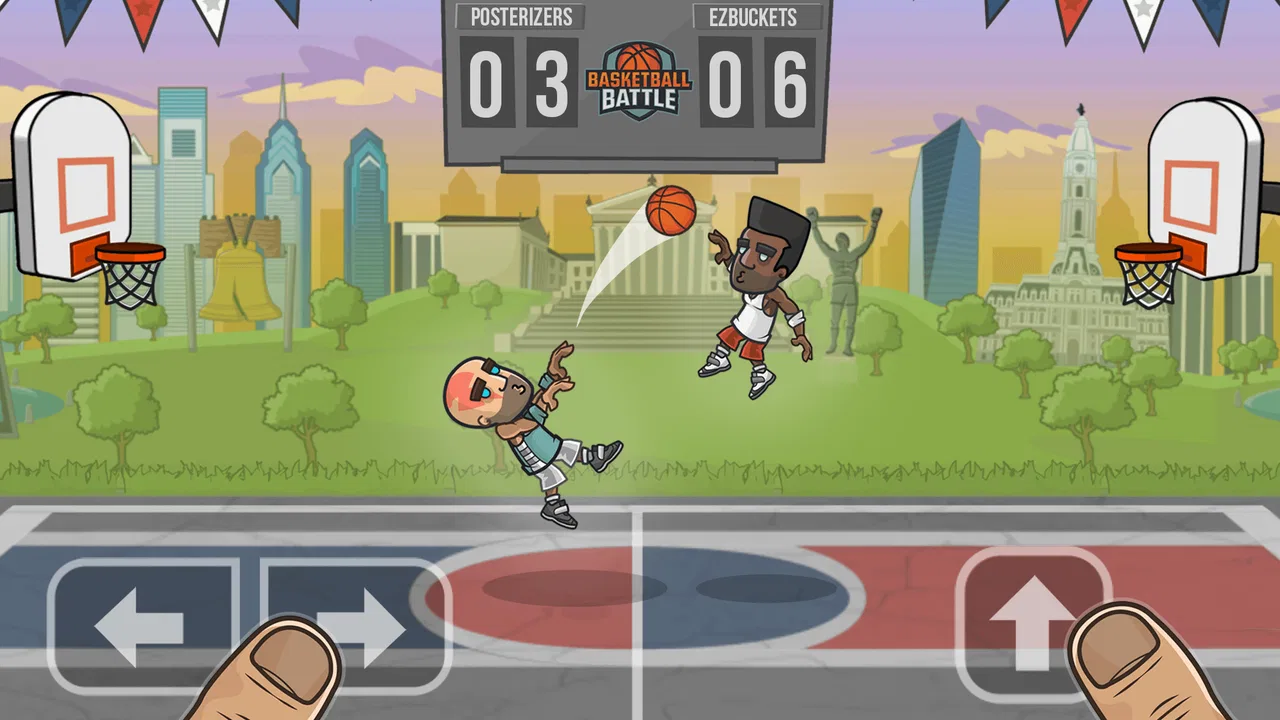
The controls are designed around quick decisions rather than a large collection of buttons. That makes the first few attempts comfortable, but it also means that success depends on learning the timing and feel of the interaction. I had to pay attention to when an action was available and avoid treating every possession as an invitation to rush.
My most useful adjustment was to stop thinking only about scoring. The defensive side of the exchange matters just as much. If I focused on attacking without considering how the opponent could answer, I gave away the advantage I had created. Once I began treating each possession as a small sequence instead of a single shot, the matches became more interesting and my mistakes became easier to understand.
This is one of the less obvious strengths of the game: it rewards restraint more than frantic tapping. A new player may assume that speed is always the answer, but the better habit is to watch the situation, choose the sensible opening, and accept that not every possession needs to become a spectacular attempt. That lesson carries over well when playing on a small screen, where hurried inputs are especially easy to make.
How a short match feels in everyday use
I found the game particularly convenient in the kind of situation where I have only a few minutes, such as waiting for an appointment or taking a break between tasks. It does not require me to prepare a long session mentally. I can open it, play, and put it down without feeling that I have abandoned a complicated campaign halfway through.
That convenience does not mean every session feels identical. My attention changes the result more than I expected. When I play while distracted, I tend to force chances and lose the rhythm of the matchup. When I give the game my full attention for a short period, the same basic controls feel more deliberate. The compact format therefore works best when I want a small challenge, not when I am looking for something to play in the background.
Another practical point is that the game is free to start, which lowers the risk of trying it. The age rating is Everyone, so it is positioned as an accessible choice for a broad audience. However, free entry does not automatically mean that every player will enjoy the progression or optional spending elements. I would approach the in-app purchase range carefully and decide in advance whether I want to play without buying anything.
A useful routine for improving without grinding blindly
My advice is to use short practice cycles instead of repeating matches without thinking. After a loss, I would identify one specific problem: rushing an attack, failing to protect a lead, or choosing a low-quality opportunity. Then I would play again with only that issue in mind. This makes improvement feel more measurable, even though the game itself remains fast and simple.
A second helpful habit is to separate experimentation from winning. When I tried a different approach, I sometimes lost, but I learned more about how the matchup responded. If I used every game only to chase the result, I became predictable and frustrated. Treating a few attempts as testing sessions helped me understand the timing and made later victories feel earned rather than accidental.
Players using an older device should also keep expectations realistic. The current version is 2.4.46 and requires Android 6.0 or later, so compatibility is broad but not unlimited. On a supported phone, the important question is less about having the newest hardware and more about whether the touch response feels comfortable. A small or aging screen can make precise interaction less pleasant than it would be on a modern device.
Where the game delivers its best value
I find the game’s best value in how quickly it turns spare time into a focused contest: I can make a few decisions, learn from a mistake, and leave without committing to a long session. The useful test is whether that compact loop keeps me curious about improving my next possession, rather than whether I can unlock something quickly. That distinction makes it easier to judge its staying power on your own terms.
The ideal quick-competition scenario
The best scenario for me is a short, focused break when I want a clear outcome. Imagine having ten minutes before a train arrives. I can play a few contests, notice whether my decisions are improving, and stop at a natural point. That is more satisfying than opening a large sports game that expects a longer commitment.
It also works well for someone who likes sports but does not follow every technical detail of basketball. The basic goal is immediately recognizable, while the touch interaction provides enough involvement to make each attempt feel personal. I do not need to understand advanced basketball terminology to enjoy the challenge. I only need to read the opening, react to pressure, and make better choices than I did in the previous possession.
For families, the Everyone rating makes the game easier to consider as a broadly suitable sports option. I would still recommend that adults review the spending settings before handing a device to a child, because the game includes in-app purchases ranging from $0.99 to $99.99 per item. That range is a practical reason to use device-level purchase controls rather than assuming that a free download has no financial considerations.
Why the format is more useful than a full simulation in some cases
Compared with a traditional basketball simulation, this game is less intimidating. A simulation may offer more authenticity, but it often asks the player to manage many actions at once. Basketball Battle is better when I want the feeling of competition without learning a complete control system.
Compared with a simple endless arcade game, it gives my decisions more weight. The contest structure makes me think about the opponent instead of only chasing a personal score. That difference is important: the game feels like a matchup, not merely a reflex test. Still, players who prefer endless score chasing or elaborate career progression may find a different sports game more rewarding.
The developer, DoubleTap Software, has kept the central idea easy to recognize. The result is not a complicated product, but simplicity is doing real work here. It reduces the time between opening the game and making a meaningful decision. For a phone game, that is a valuable design choice rather than a missing feature by itself.
What can make the experience less comfortable
The same compact design that makes the game accessible can eventually feel repetitive if I play for too long in one sitting. Because the core exchange remains focused, extended sessions depend on my enjoyment of refining small decisions. If I need constant novelty, a broader sports title with more modes may hold my attention better.
There is also a difference between being easy to start and being easy to master. I understood the general idea quickly, but consistent results required patience. Some players may interpret an early loss as unfair when the real issue is hurried timing or poor reading of the situation. The game would be a poor choice for anyone who wants immediate success with no learning curve at all.
Optional purchases are another point to consider. The game is free, which is convenient, but the presence of paid items means that the most comfortable experience may depend on how each player approaches progression and customization. I would not recommend spending impulsively after a frustrating match. First decide whether the basic loop is enjoyable on its own; if it is not, buying something is unlikely to fix that underlying problem.
Who will get the most from Basketball Battle
I would recommend it first to casual sports fans who want short contests, simple touch controls, and a reason to improve from one attempt to the next. It is also a good fit for players who enjoy competitive pressure but do not want a long management system. The game’s broad audience positioning, free price, and familiar basketball premise make it easy to test without a major commitment.
It suits people who like learning through repetition. The strongest players will not necessarily be the ones who tap fastest; they will be the ones who notice patterns, avoid wasteful attempts, and adjust after a mistake. That gives the game a modest but genuine skill layer. I enjoyed it most when I treated each session as a chance to sharpen one decision rather than as a demand to win every time.
It is less suitable for someone seeking a realistic basketball season, detailed rosters, deep coaching choices, or a large social sports ecosystem. It is also not my first choice for passive play, because the short exchanges reward attention. If I only have one hand free or expect to be interrupted constantly, I would choose something less dependent on timing and concentration.
The game’s popularity suggests that its straightforward format has connected with a large audience: it has passed 50 million installs, with an average rating of 4.6 from roughly 491 thousand ratings and about 53 thousand written reviews. Those figures do not replace personal testing, but they do match my impression that the central idea is easy for many players to understand. The important question is whether that focused loop matches your taste.
After using it, I see Basketball Battle as a strong pick for quick basketball competition rather than a universal sports recommendation. It gives me a clear capability, puts that capability into action without much setup, and leaves enough room for better timing and smarter choices. Its limitations are equally clear: the scope is narrow, extended play can feel repetitive, and optional purchases require sensible boundaries.
For me, the deciding factor is the kind of session I want. If I need a compact game that lets me challenge myself during a spare moment, I would happily keep it installed. If I want the depth of a full basketball simulation, I would look elsewhere. As a free sports game from DoubleTap Software, it earns its place by making one focused idea enjoyable, readable, and surprisingly demanding once I stop playing on autopilot.
FAQs for Basketball Battle
01What is Basketball Battle and how does it work?
Basketball Battle is a fast-paced, one-on-one basketball game for mobile devices. Players can control their character to shoot, steal, and dunk their way to victory. The game features intuitive touch controls, allowing for quick movements and actions. Players compete in tournaments across different locations, aiming to climb the leaderboard and earn rewards.
02Is Basketball Battle free to play, and are there in-app purchases?
Yes, Basketball Battle is free to download and play. However, it offers optional in-app purchases that can enhance the gaming experience. These purchases may include special currency, unique outfits, or other performance boosters. Although not necessary to enjoy the game, they can help players progress more quickly or customize their characters.
03What are the minimum device requirements to play Basketball Battle?
Basketball Battle is designed to run smoothly on most modern Android and iOS devices. To ensure optimal performance, a device with at least 1GB of RAM and a recent operating system version is recommended. Older devices may still support the game, but users might experience slower performance or reduced graphics quality.
04Does Basketball Battle have a multiplayer mode?
Yes, Basketball Battle offers a multiplayer mode where players can challenge friends or compete against others online. This adds an exciting competitive element to the game, allowing players to test their skills against real opponents. Multiplayer matches require an internet connection to ensure smooth gameplay and accurate leaderboards.
05What customization options are available in Basketball Battle?
Players can personalize their characters with various customization options in Basketball Battle. These include choosing different outfits, accessories, and shoes to create a unique look. Additionally, players can enhance their character's skills and abilities by leveling up and unlocking special moves, providing both visual and gameplay customization.
Pros
- Simple and intuitive controls.
- Engaging multiplayer mode.
- Offline play available.
- Quick match setup.
- Cartoonish
- fun graphics.
Cons
- Limited customization options.
- Repetitive gameplay over time.
- In-app purchases can be pricey.
- Occasional lag in multiplayer.
- Ads can be intrusive.

Basketball Battle
Gallery